Pure Culture
Distributed biological protein production as a response to global food system fragility.
Active Project
Pure Culture
Distributed biological protein production as a response to global food system fragility. Replacing centralised animal agriculture with networks of farm-scale cultivation — and ultimately, the household kitchen.
Industrial animal agriculture is fragile, land-intensive, and optimised for a set of constraints that no longer hold. Transition to biological protein production is not a preference — it is an infrastructural necessity.
The technical barriers are largely solved. The obstacles are institutional and cultural: incumbent capital, regulatory frameworks built around slaughter, and a consumer relationship to food that resists argument.
Rather than competing with the incumbent system, Pure Culture converts it. Farmers repurpose existing infrastructure for biological manufacturing. They retain their land and livelihood. We gain distributed production at scale.
Global protein demand is projected to increase by approximately 70% by 2050. Conventional animal agriculture currently occupies 80% of agricultural land while supplying 20% of global caloric intake. That asymmetry is a fragility problem: a system this resource-intensive, with this many single points of failure, is not a stable long-term architecture.
Disease events routinely remove millions of animals from production in weeks. Climate events disrupt feed grain supply chains with increasing frequency. Water scarcity is constraining production in regions that historically supported high livestock density. The system is not broken. It is operating exactly as designed — which is the problem. It was designed for a set of environmental and economic conditions that are no longer reliable.
The technical barriers to cultured meat production have been progressively reduced for two decades. Growth media costs have fallen by orders of magnitude. Bioreactor technologies are advancing. Regulatory frameworks are emerging in major markets. The technical barriers are not what is limiting adoption.
The primary barriers are institutional. The incumbent protein supply chain represents a multi-trillion dollar capital stock — in land, in slaughter infrastructure, in processing facilities, in cold chain logistics. Incumbent operators have strong economic incentives against transition, and regulatory frameworks were designed around their operations. The secondary barriers are cultural: food is one of the most emotionally and historically embedded domains of human behaviour. Technical reassurance does not address the consumer's relationship to the concept of biological manufacturing.
Pure Culture does not attempt to replace the incumbent system through direct competition. It converts it. Agricultural infrastructure — barns, cold storage, water systems, land — is highly compatible with biological manufacturing. We provide the biological systems: starter cultures, growth media formulations, farm-scale bioreactor units, quality assurance protocols. The farmer provides the infrastructure they already own. The economic model is a production partnership.
This approach addresses the institutional barrier directly: we are not asking farmers to abandon their livelihoods. We are offering a different use of infrastructure they have already invested in. It also addresses the cultural barrier indirectly: cultured meat produced by farms carries a different cultural provenance than product from an urban technology facility.
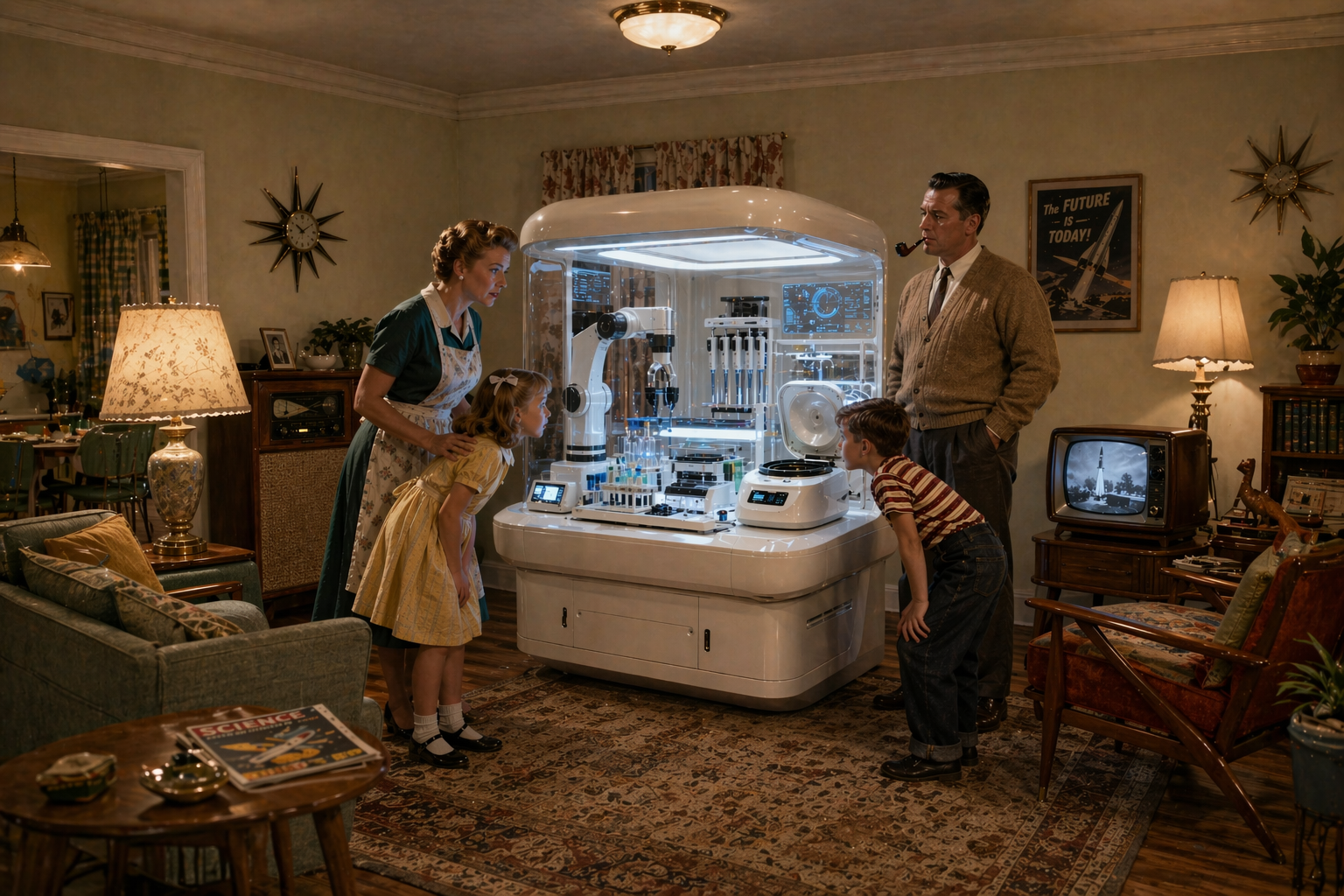
The terminal architecture of Pure Culture is not farm-to-retail. It is farm-to-retail-to-household. We are developing a consumer cultivation unit — a kitchen appliance that maintains a small-scale biological culture from which the household produces protein on a regular cycle. The unit receives starter culture by subscription. It requires no specialist knowledge to operate.
This is not a near-term product. It requires consumer familiarity with cultured protein — which the farm distribution network builds — and a cost reduction in bioreactor technology that scaling of farm production drives. The household unit is the endpoint of a decade-long infrastructure development. The farms are building the cultural and economic conditions that make it viable.
Distribution Model — Three Phases
01
Central Production
Mammalian Biotech operates dedicated cultivation facilities producing Pure Culture products at controlled, auditable scale. This phase establishes quality benchmarks, cell line integrity, and consumer safety protocols. Volume is limited. Reach is direct.
Active02
Farm Network
Partner agricultural operators convert existing infrastructure — barns, polytunnels, converted livestock buildings — to cell cultivation use. Mammalian Biotech supplies certified cell lines, growth protocols, monitoring systems, and guaranteed offtake agreements.
Deployment03
Consumer Unit
The Pure Culture home unit — PC/H — produces fresh cultured protein on a 7–14 day cycle. Cell line subscriptions replace retail supply chains. Cold storage and transport requirements drop to zero. The kitchen is the facility.
In DevelopmentFull Research Paper
Pure Culture: Distributed Biological Protein Production as a Response to Global Food System Fragility