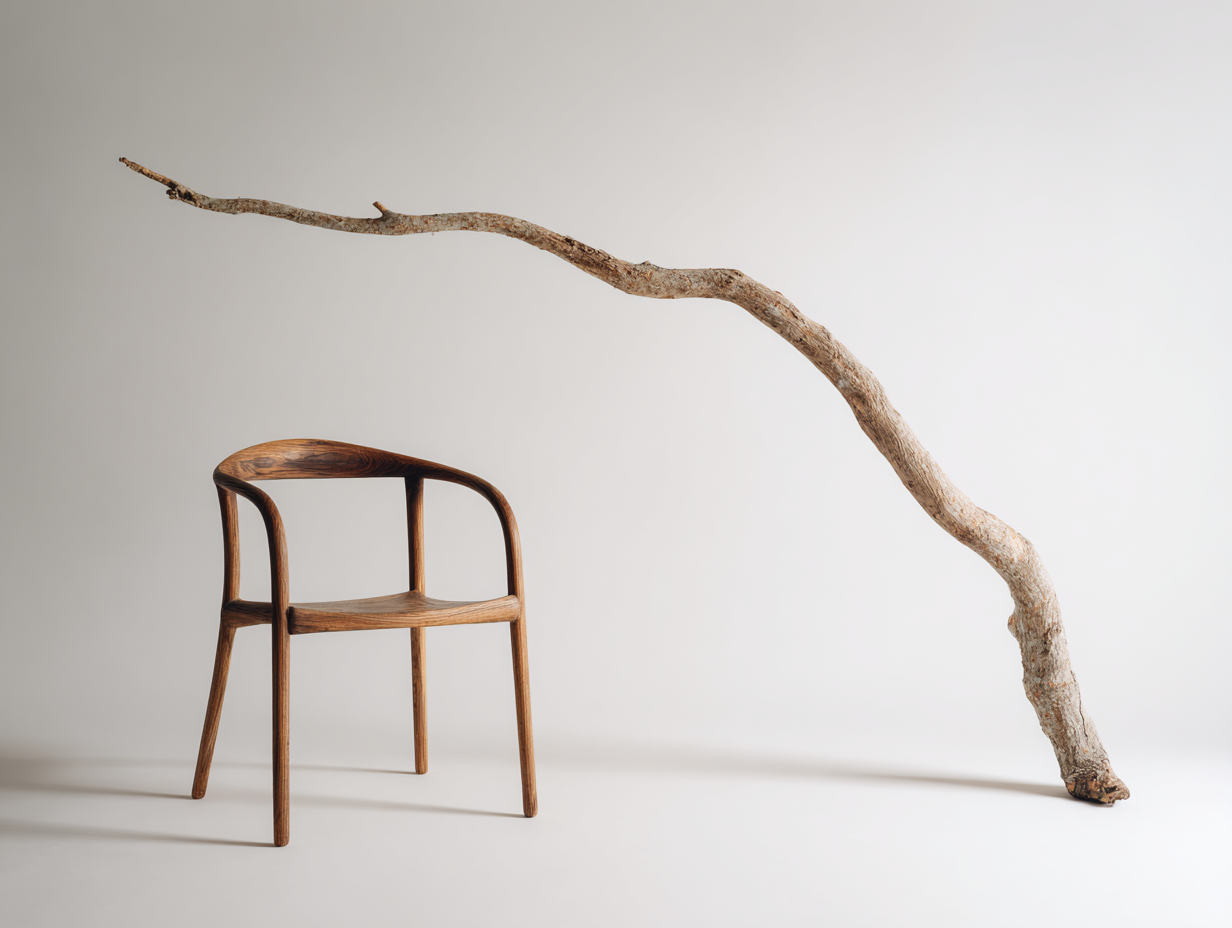
Form
Directed growth of woody perennial organisms into finished structural objects. No extraction. No milling. No joinery.
Timber extraction is the organised removal of living systems. Form encodes the destination into the organism. It grows there.
Fifteen billion trees are cut annually to produce objects that could be grown. Form eliminates timber harvesting for the structural object market — not by reducing it at the margin, but by replacing the supply chain entirely.
Existing agricultural infrastructure provides the distributed environment for Form's first commercial phase. Polytunnels, glasshouses, and converted farm buildings are sufficient. Farmers gain a predictable, contract-based income stream with no commodity price exposure.
The long-term endpoint is a domestic growth unit — a compact biological system allowing consumers to cultivate structural objects in their own space. A seed goes in. Furniture comes out. The supply chain disappears.
The problem
The global logging industry extracts 15 billion trees per year. Old-growth forests that took centuries to form are cleared, replaced by fast-growing monoculture plantations selected for yield rather than ecological function. Eucalyptus and pine grow fast. They perform none of the ecological work of the forests they replaced: no carbon density, no watershed stability, no biodiversity, no mycorrhizal complexity. Meanwhile, the timber supply chain converts harvested biomass to finished objects at roughly 15% material efficiency. The remainder is waste.
The result is a system that destroys living ecosystems to produce chairs at 15% efficiency, then calls itself sustainable because it plants eucalyptus.
The approach
Form uses targeted genetic sequence modification to encode the required structural geometry directly into an organism's developmental programme before growth begins. The organism grows into the finished object. There is no extraction phase. There is no milling phase. There is no joinery. The manufacturing process is growth.
This is not post-growth manipulation. The geometry is in the sequence. Current prototype work is producing functional objects — stools, shelf brackets, curved panels — grown as single organisms from modified planting stock. No joints. No assembly. No waste.
The path to scale
Form's first commercial phase uses existing agricultural infrastructure. Farm operators receive modified planting stock, growth environment specifications, and a guaranteed offtake agreement. Their covered structures — polytunnels, converted livestock buildings, glasshouses — provide the climate stability the growth cycle requires. No specialist construction. No significant new capital expenditure.
A network of distributed farm operators growing to specification is more resilient than an equivalent centralised facility. Form projects 200 farm operators in production within 36 months of commercial launch, covering 12 object types.
The consumer endpoint
The Form domestic unit — Form/H — is in parallel development. A compact, self-contained growth environment designed for a garage or utility room. The consumer selects an object from the Form catalogue, installs a prepared planting unit, and monitors growth via a companion application over a 10–18 month growing cycle. At the end of the cycle, the object is complete. No assembly required.
The supply chain between forest and living room no longer exists. The living room grew the furniture.
Form: Directed Organismal Architecture as a Response to the Global Timber Extraction Crisis